dingbat

News

Little Brother BBtv vlog

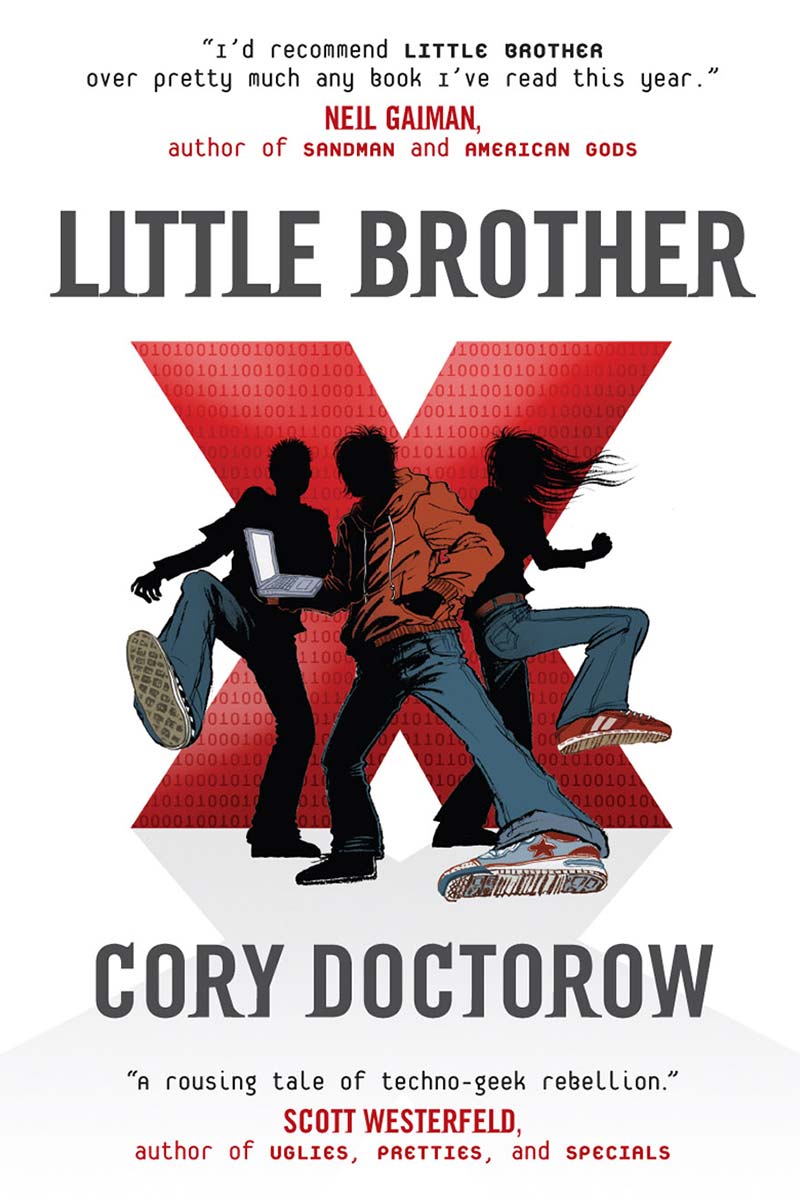
Here’s another installment of me reading from the book on BBtv!

Vlog of me reading from Little Brother on BBtv

I’ve been recording vlogs of me reading from Little Brother for BBtv — here’s the latest installment!

Link

Readers’ video for Little Brother — fantastic!

Young adults in Evanston, IL worked with a teen librarian to make this unbelievably fantastic video based on Little Brother, reenacting the opening section of the book in painstaking detail (look at them limping from the gravel in their shoes!). This is so fantastically great.

Link

Little Brother proper-name visualization

Jeff Clark made this bad-ass “StreamGraph” of the word-frequency distributions in Little Brother — they show how often proper names were used in the course of the book. It’s a really fascinating look into the novel’s storyline.

Link

(Thanks, Jeff!)

William Gibson and Ean Cooke on Little Brother

The flood of positive reviews for Little Brother has been nothing short of amazing, but two very special ones came in today. One is from John E. Cook’s son Ean, left on their kitchen whiteboard last night after Ean finished the book (pictured here), the other from my friend and colleague William Gibson: “I’ve not previously expressed my admiration for Cory Doctorow’s Little Brother. As Wm. Burroughs was fond of saying, “young boys need it special”. In the case of Cory’s book, though, young girls need it special too.”

Talk at Google NYC


At the end of my book-tour last month, I stopped at the Google NYC office and did a reading from the book and spoke about general subjects related to it.
Link

Hand-bound one-of-a-kind edition

Book-binder Abi Sutherland took one of the misprints from Pablo Defendini’s limited edition prints of his concept art for a paperback edition of my young adult novel Little Brother and custom-bound a hardcover of the book with it. I am consumed with lust for this one-of-a-kind edition. I hope Abi will let me see it in person some day!

Oh, and while I’m on the subject: the book’s just gone into its fifth week on the NYT bestseller list, and it’s still on the Indie list (formerly the Book Sense list) and as of this week, it’s also on Publishers Weekly’s bestseller list! Ho-ah!

Link

Update: Abi sez,

Slight corrections: it’s a blank book rather than a copy of Little Brother, mostly due to printer constraints. Printing out a whole book double-sided on my printer would be soul-destroying, and I don’t have signature-sewn editions to tear down.

The binding is a “sewn boards” binding, about halfway between hardcover and softcover. The paper that Pablo used for the prints has such a nice feel and weight; I wanted to work with its sensual qualities.

And I confess that it’s not one of a kind. I plan to make five or six of this set, one of which will be heading your way in the very near future. I was going to surprise you with it, but that requires secrecy. I got too excited about how the book came out and had to show it off: secrecy fail.

Interview in The Onion

Last week, I conducted a long phone interview with The Onion’s Tasha Robinson, who’s reviewed a lot of my work for The Onion in years gone by. We had a great conversation and to my delight, Tasha’s put up the whole transcript of the chat, which covered a lot of ground.

I think that young kids have rarely been people who have disposable income and spend it well. As a writer, I had the good fortune to work in a bookstore that sold new and used books, so I got a real cradle-to-grave view on what happens to creative work, and how audiences mature. So you’d see people coming in who are very young, who had a little pocket money, and would just buy used books. And sometimes they would say, “If someone brings in this new book as a used book, please give me a call. I’d like to be the first person in line to buy it.” And we would actually have someone on staff whose job it was to take the used books that came in, and look them up in the computer to see if anyone was waiting for them, and if they were, to call them up and tell them there was a copy for $2 waiting. As those people cultivated the habit of reading, and more money became available to them, they would spend more freely in the store. Really, what changed wasn’t their willingness to pay, it was their ability to pay, and maybe in our own minds, we conflate those two. In general, when you reach a certain point in your life cycle as a buyer, the cost of a book is not something you generally notice.

It’s kind of like the buyer who walks into a store and is thinking about buying a candy bar, and one of them is priced at $.99 and the other is priced at $1.10. For a little kid, that might make a difference. For adults on their way out of the store with $75 worth of groceries, it makes no difference at all. They’ll pick the candy bar they want, not the one that’s $.11 cheaper. So there’s a certain price sensitivity that evaporates when you get older. And then when you get older still, when you become someone on a fixed income, it reappears. And you see that whole lifecycle of people when you work in a used bookstore, and I kind of feel like what I want to be sure of is not that every time someone reads my book, I get paid for it. I’m more interested in making sure that every time someone decides to make what I call a macro payment, to spend a bunch of money on an entertainment decision, that I’m really close to the top of their wish list of what they want to spend it on. And I think you see this with things like the Nine Inch Nails release, or the Radiohead release, where really, what they were trying to do is say to the people who are cash-poor and time-rich, “Just take this and go around and promote the hell out of it. Go and act as breezes to loft my seeds to every corner of the globe.” Because if you do that widely enough, if you cast those seeds widely enough, some of them will germinate in really fertile soil, some of them will land in the pocket of a guy who’s got a ton of disposable income, who’s sort of 18-34, single, working his first job, his first major professional job at a college, with lots of money jingling in his pocket, who might think, “Holy crap! $300 limited-edition Nine Inch Nails box set, yeah, I’ll take one of those!”

I’m way more interested in, instead of trying to turn the 15-year-old upside down and shake an extra couple of quarters out of his pockets, in how I can use his natural loquaciousness, his natural enthusiasm, to help get the message out about really high-ticket items, like a $20 hardcover, into the ears of people who routinely buy $20 hardcovers without even blinking.

Link

Little Brother encoded as microdots on a papercraft desk-jar

Flickr user Oschene created this papercraft compass rose jar on which is printed the entire text of my novel Little Brother, encoded as “1.7 gazillion microdots”: “One has only to unfold the model, scan it and reconstitute it into a readable text.”

Link


Seeking techno-triumph stories of anti-authoritarian battles for UK edition of Little Brother

Have you used technology to overcome the odds when fighting back against authority? I’d love to hear about it!

The UK edition of my young adult novel Little Brother is coming out next November, and HarperCollins, the UK publisher, have asked me to come up with some new material for the British book. I’m noodling with a bunch of different ideas on this score, but one of my favourites is of compiling an appendix of real-world stories of people who’ve successfully used technology to subvert authority and level the playing field between just-regular-folks and The Powers That Be.

To that end, I’m interested in getting your stories — ones that you’re happy to have published — of technological triumph over blind, goofy, obdurate authority. Post them here on the post or email me with them. If I get enough great material, I’ll make it an appendix in the Brit edition!

Creative Commons License

Little Brother is proudly powered by WordPress
Entries (RSS) and Comments (RSS).